Optimize Your Casting Materials: How to Clarify Your Casting DNA™
Prefer to watch? Here’s the video….
Scroll to read….
One of the hardest things about being an actor is the chicken-and-the-egg problem.

It’s hard to get auditions without a demo reel and it’s hard to build a demo reel without auditions.
And when you finally book something, it can feel random, like spaghetti thrown at the wall.
But you take the job and you’re grateful and proud.
And slowly, without realizing it, a pattern begins to form.
Not because you made a mistake or you’re off track, but because a signal emerged.
If you want to optimize your casting materials, you have to understand this first:
Your materials are already sending a message.
The real question is whether that message is intentional or accidental.
The Signal Is Already There

Martin Donovan & Adria Tennor in Hal Hartley’s Amateur
My first professional job out of college was playing a 12-year-old boy in Hal Hartley’s Amateur. I was 22 and it was an extraordinary opportunity. His films played at Cannes and this one did too.
At the time, it felt like a breakthrough and in many ways, it was.
Two years later, when the film was released and I finally received footage for my demo reel, I walked that reel around New York City on VHS tapes to agents and casting directors.
I was ecstatic to finally have professional material, but over and over, I heard the same thing:
“You dropped off the wrong tape. It’s just two men.”
One of them was me.
What followed wasn’t rejection, so much as interpretation.
Casting directors began seeing me as masculine. I started getting called in for roles that didn’t fully align with who I was or how I naturally functioned in the story.
It took me years to understand that I wasn’t cast as that boy because I was masculine.
I was cast because 12-year-old boys are often scrappy, gamine, resilient, and self-possessed. These were all qualities I naturally had.
The signal wasn’t wrong. I just didn’t fully understand it.
And more importantly, I wasn’t intentionally amplifying it in a strategic way.
That distinction changes everything.
How Casting Patterns Actually Form
Actors often feel frustrated by patterns.
“Why do I keep getting called in for this type?”
“Why can’t they see my range?”
“Why do they misunderstand me?”
But casting directors are not guessing. They’re responding to information you provide for them.
Your:
Demo reel
Self-tapes
Headshots
Resume
Bio
Clips
Press
And You
All of these elements work together to create patterns.
And these patterns create expectations.
From the industry’s perspective, they are responding logically to the strongest signal you’re sending.
If your materials consistently show you anchoring grounded authority with emotional restraint, that’s the role they’ll call you in for.
If your reel highlights volatility and intensity, that becomes your signal.
Booking work doesn’t automatically create clarity.
Clarity comes from interpretation.
If you don’t interpret your own signal, someone else will do it for you.
And they may interpret it in a way that doesn’t fully serve you or showcase how you naturally function in a role.
Why “Showing Range” Often Backfires
Many actors are told to “show range” in their demo materials.
It sounds intelligent and impressive.
But range without clarity creates confusion.
If your reel presents wildly different versions of you with no through-line, casting doesn’t see versatility.
They see confusion, and more importantly, they move on because they don’t clearly see what they’re looking for .
When materials feel scattered, they have to work harder to categorize you, they just don’t have time to do that work for you.
Optimizing your casting materials is not about proving how much you can do.
It’s about communicating what you naturally do best and allowing your range to expand outward from that center.
The clarity has to come first and expansion second.
When casting understands your core function in the story, they can naturally imagine you in multiple variations of that function.
That’s true range.
What It Really Means to Optimize Your Casting Materials
When actors think about improving their materials, they usually focus on upgrading:
Better headshots
Sharper footage
Higher production value
A new demo reel edit
Those upgrades can absolutely help, but optimization is not primarily technical.
It’s strategic.
To truly optimize your casting materials, you need to ask deeper questions:
What emotional role do I naturally play in the story?
When I enter a scene, what shifts?
What energy do I anchor?
What is my gravitational pull?
Your casting materials should not simply document your past work.
They should communicate:
How you function inside a story
What you bring into a room
What roles you naturally anchor
Where you are capable of expanding
When those elements align, casting stops squinting at you because they see you clearly.
And clarity is bookable.
How to Build a Demo Reel That Communicates Your Casting DNA
When you sit down to edit your demo reel, it’s tempting to organize it by milestones:
Your first professional job.
Your most prestigious credit.
Your most recent booking.
Those moments matter. They’re part of your journey.
But your reel isn’t a scrapbook.
It’s a positioning tool.
The more useful question isn’t: “What’s my biggest credit?”
It’s: “Which clip most clearly communicates my casting DNA?”
Sometimes that is the network job. Sometimes it isn’t.
Sometimes a self-produced scene captures your essence more precisely than a supporting role in a major film.
In my own career, the project that has generated the most meetings and opportunities for me — more than many traditional credits — was a short film I wrote, directed, and starred in called Pie, alongside Jessica Paré.
I made it because I wanted to capture something specific about how I function in story — the tonal tension, the emotional precision, the undercurrent that doesn’t always fit neatly into a guest star box.
That film that I wrote for myself has opened more doors than almost anything else on my resume.
And the same thing happened earlier in my career.
I booked Mad Men because casting directors Josh Einsohn and Laura Schiff came to see a self-penned solo show I created and produced called StripSearch. They weren’t responding to a resume line.
They were responding to me shining in my own story, my own material.
They saw something specific in how I functioned inside material I had written for myself — and they brought me in to audition for Matthew Weiner.
That was not an accident.
That is clarity.
Sometimes a self-produced piece captures your casting DNA more precisely than a supporting role in a major film. Because when you create your own work, you are often closer to your essence.
Optimizing your demo reel is about precision.
A tightly curated 60–90 seconds that clearly communicates your essence will outperform a longer compilation of disconnected random performances.
Casting isn’t looking for the longest list.
They’re looking for the clearest signal.
And sometimes the clearest signal comes from the work you created yourself.
When the industry watches your reel, they’re not conducting a career audit.
They’re scanning to see if you can play the role they’re trying to fill.
Your job is to make that answer obvious. When your reel is aligned with your Casting DNA, it stops feeling like a moving picture of a map of where you’ve been and instead becomes an invitation to go along with you on your way to where you want to go.
The Overlooked Power of Your Actors Access Bio
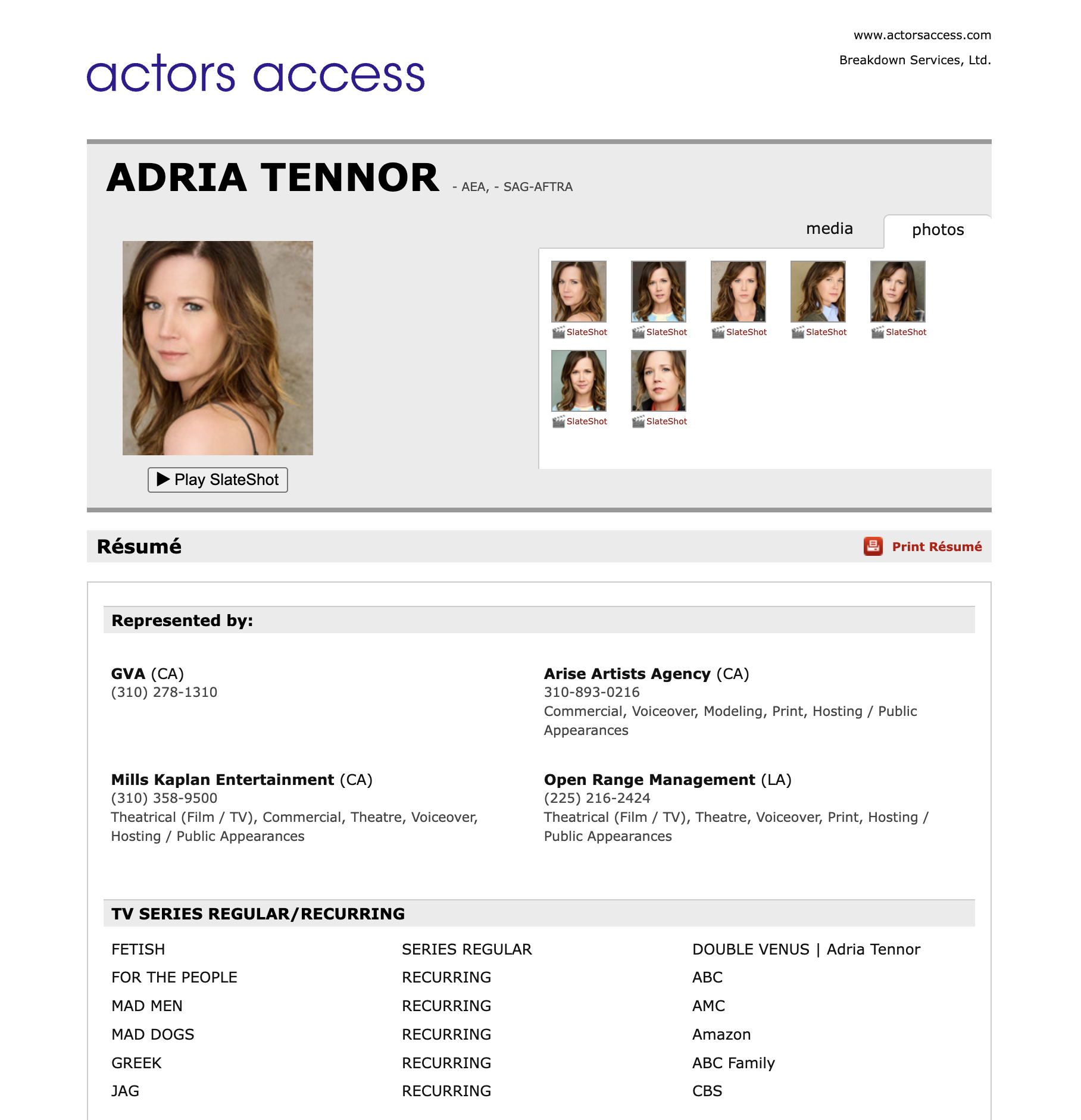
Credits are evidence. But they’re not identity.
Actors Access is built to catalog what you’ve already done.
The bio is the only space where you get to declare who you are.
That distinction matters.
You are not confined to the narrow lane of what you’ve booked so far.
You can articulate your casting essence.
You can clarify the emotional function you serve in a story.
You can position yourself toward the work you are actively moving into.
That kind of intentional language creates cohesion.
And cohesion builds trust.
You No Longer Have to Wait
Years ago, actors had to wait for the jobs they were able to book to be released to get footage.
They had to wait for someone else to pick them to define their type.
That’s no longer true.
You can now:
Self-produce scenes
Create targeted self-tapes
Strategically curate your reel
Refine your bio language
Align your headshots with your casting identity
This shift is powerful, because once you understand your Casting DNA, you can take control of your career and really showcase your talent.
Instead of hoping that casting sees you clearly, you can show them exactly how to see you.
A Reflection Exercise to Clarify Your Casting DNA
Before you overhaul your materials, pause and ask yourself:
What kinds of roles do I consistently book?
What qualities do those roles share?
When I’m at my strongest in a scene, what energy am I anchored in?
What do people consistently comment on about my presence?
Does my current reel amplify that signal or dilute it?
Notice your patterns without judgment.
Patterns are not there to box you in.
They’re information, and that’s power.
When you understand your own pattern, you can decide whether to lean into it, refine it, or strategically expand it.
But you can’t expand from confusion.
If you want help exploring your materials I created a free tool called Casting DNA™ PreCheck - it’s a Custom GPT that talks you through a comprehensive audit of your casting profile materials and helps you get specific about how you’re actually transmitting yourself to casting — this helps you have agency over your own materials AND make clearer choices about what goes on your casting profiles—and how you’re showing up.
What Casting DNA Actually Is
Casting DNA is not typecasting.
It’s not about shrinking yourself or limiting your career.
It’s about defining your essence.
Who are you before you speak?
What qualities are present when you enter a room?
What emotional function do you naturally serve in the story?
Essence reads before technique, polish or range.
If your essence is unclear, everything built on top of it feels unstable.
When your essence is clear, everything strengthens:
Scene choices become sharper.
Self-tapes feel grounded.
Headshots align.
Reels tighten.
Confidence increases.
Because you understand the signal you’re sending.
And once you understand it, you can amplify it intentionally.
Clarity Changes Everything
If your casting feels confusing…
If your auditions feel mismatched…
If your materials feel scattered…
Nothing went wrong.
Your signal is there, but if you don’t consciously shape it, it shapes itself.
And sometimes that means the industry interprets you in ways that are partially true, but not fully aligned.
The goal is to clarify yourself.
It’s a subtle difference with a massive impact.
The Casting DNA PreCheck GPT
After decades of seeing this pattern, in my own career and in the actors I coach, I created a free tool called the Casting DNA™ PreCheck GPT.
It helps you:
Look at your current materials objectively
Identify the signal they’re already sending
Recognize patterns without judgment
Clarify what to amplify moving forward
It’s not a personality test or a label.
It’s a mirror to help you see yourself clearly.
And sometimes clarity doesn’t come from adding more.
It comes from seeing what’s already there.
You can access the Casting DNA PreCheck GPT here:
If you try it, let me know what you find out! I geek out on this stuff!!
Final Thoughts: Clarity Creates Momentum
When your casting materials align with your essence, something subtle shifts.
Casting stops trying to figure you out and they start imagining where to place you.
Clarity creates career momentum and opportunity.
And once you have that, casting stops feeling random.
Optimizing your casting materials isn’t about gaming the system.
It’s about understanding the signal you’re already sending and amplifying it intentionally.
That’s when your materials start working with you instead of against you.
And that’s when casting begins to see you clearly. ✨
